

Some text.
A press of a button.
You push.
Contemplating. Pondering. Ruminating. And, then what happens?
Magic.
What’s in front of you is that polished interface. The UI elements you’ve been craving. Put together, they look so sleek. “Ship it,” someone states in the background.
It’s so gratifying. You can’t stop.
Enter text. Press. Enter text. Press. Enter text. Press.
That backlog item that’s been sitting there for three years: done.
The vocal customer’s feature request: done.
The CEO’s “over the weekend” idea: done.

Features galore. Got a feature? Let’s build it!
The floodgates have been opened. That built-up frustration over years has finally been released.
It’s thrilling, exhilarating to finally “get things done”.
…or…should it?
Frankly, this zeitgeist scares me.
Don’t get me wrong. AI is like magic, but when talking to teams, I start to see patterns and the other, not-so-exhilarating story.
This is the dark side.
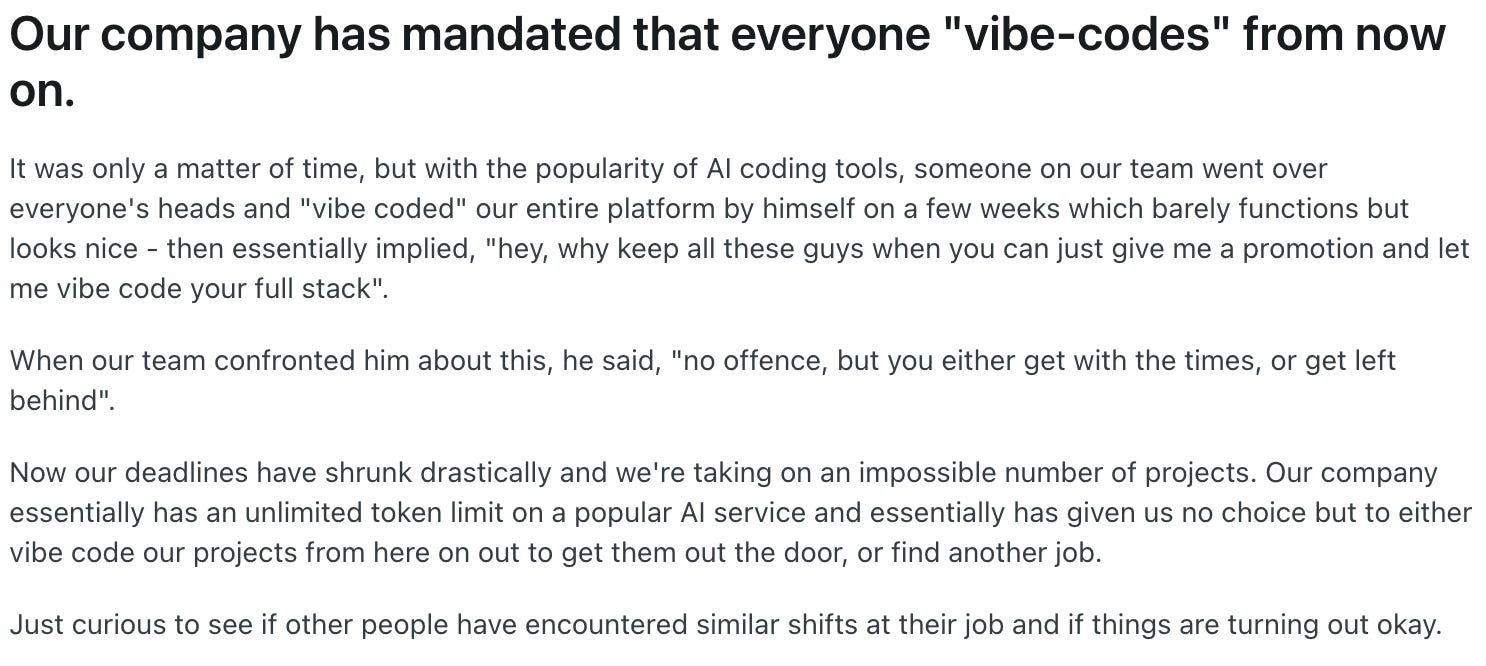
(found on Reddit)
WTF.
Granted, this is a highly dysfunctional organization that will most likely go bankrupt in the near future. But if this is the end of the spectrum of toxic usage of AI, where are you on the scale?
From that feature being quickly visualized, to this. It’s a slippery slope.
So.
What can we do to avoid this tsunami of ill-conceived features?
Deep down inside you know what to do.
Over the last 20 years, we’ve built up awesome collective wisdom of what it takes to create features customers want.
Right now, it seems that we’re in a state of amnesia. We’re hypnotized by the allure of AI and as a result we’ve forgotten the basics of sound product development.
Concepts such as strategy, discovery, UX, “outcomes over output” all point us in the right direction.
Let’s wake up and smell the customer insights.
Before you build that AI-generated feature, ask yourself: should it be built?
If you don’t, we’re about to see the aftermath. Soon.
Maybe the biggest risk of vibe coding isn’t bad code. It’s good-looking evidence that convinces us we’re making progress.
A polished feature can create the illusion of product discovery when all we’ve really discovered is that AI can build a UI very quickly.